
A Sudden Flicker of Light: A Revisionist History of Movies: "And there it was in a nutshell: the rapture of seeing a thing and the horror of seeing it at the same time..."
a vHopeful Conversation with one of cinema's wisest, most penetrating observers, David Thomson

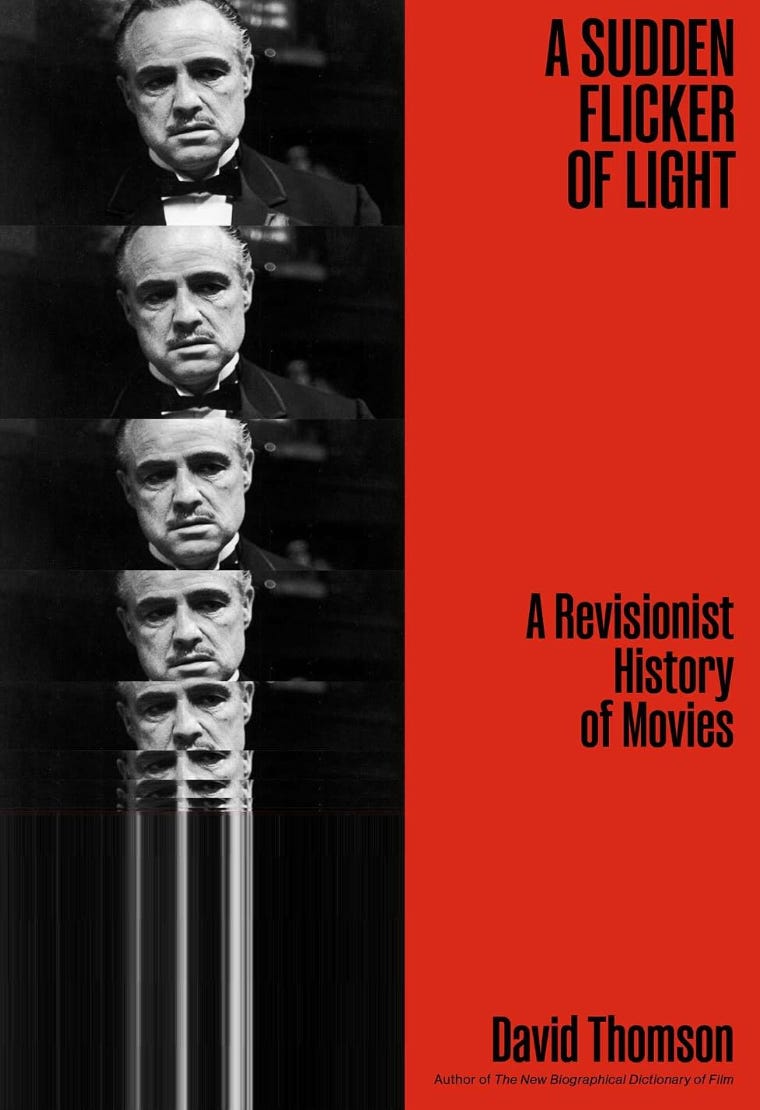
In this vHopeful Conversation, I speak with the incomparable film critic and historian David Thomson about his revelatory new book, A Sudden Flicker of Light: A Revisionist History of Movies. We trace his earliest experiences of cinema—from the terror and beauty of Laurence Olivier’s Henry V to watching Brief Encounter through his mother’s emotional response—and consider why films can both enchant and unsettle us. Our conversation moves through Hitchcock, Orson Welles, Hollywood’s treatment of women, film noir, documentary’s complicated relationship to truth, the creative force of émigré filmmakers, and the enduring work of visionary women directors. David offers a bracing critique of cinematic authoritarianism, the Oscars, and the increasingly difficult path for original independent films, while making a powerful case for curiosity, doubt, film history, and making ambitious work with less.
Transcript lightly edited. Podcast available on Apple, Spotify or wherever you listen on Dream of a Better World or Ted’s Hope for Film
Vanessa Hope: I am extremely honored to be joined by the great David Thomson, one of the all-time best film critics, one of the greatest living writers on the movies of our time. And this is the book we’re going to discuss. His latest book is called A Sudden Flicker of Light, and it is a revisionist history of movies that I thoroughly enjoyed and so connected with. It fully resonated with my life experience growing up watching movies, with family history in the movies. I could not be more excited to speak with you, David, about your book. Thank you for being here.
David Thomson: I’m overwhelmed by your introduction, and I can’t wait to see what will happen to let the whole mood down. But anyway, let’s go.
Vanessa: Let’s go. So I just want to let people know what to expect from this book, because I want everyone to buy this book so we can all start discussing movies at this level that you write about the movies. This is a career capstone of sorts: a one-volume history of film and screens as illuminating and provocative as your classic The New Biographical Dictionary of Film.
In tracing the progress of cinema from the Lumière brothers to the Coens, Thomson—David, who’s with us right now—glories in the great movies, but admits to increasing unease over what the medium has done to us: promoting fantasy, misleading models of sexual identity, and the cult of authority, power, and happy endings. This revisionist history is as alert to technology and business as it is to art and fun, in tracing our pursuit of the lifelike instead of life. By turns trenchant, lyrical, and comic, Thomson uncovers our addiction to voyeurism and villainy, and a habit of passivity that has betrayed our political and cultural identity. A survey that reaches from Metropolis to Rear Window to Anora, this will redirect ideas about film everywhere. As The New York Times has put it, Thomson proves anew that he is irreplaceable.
I actually should share that this podcast that I’ve started doing was initially inspired by Sean Baker’s longtime producing partner and co-director on his first film. Her name is Shih-Ching Tsou. She’s Taiwanese, and her film Left-Handed Girl was on the Oscar circuit last year. Because she shot that film on iPhones, I said to Ted, “Why don’t we do an interview with her to get the word out about her film on an iPhone?” And that’s how these podcasts began.
But it also came from a place of understanding how desperately needed more conversation is about the films and film culture we’re consuming in this country, as we have fewer film critics and fewer discussions, fewer opportunities to meet in theaters and share the experience of film. So I’m completely thrilled to have you here, and I wonder for you where it all began—this new thinking, this revisionist history. How did this come about?
David: Well, you know, in a funny way, I can, without being too artful or fancy, relate it to the very first film I saw, which was Olivier’s Henry V. And I would have seen it in 1945. My parents took me to see it, and it’s the only occasion I can remember where I went with both parents to see a film.
I think there was a big sense on their part that it was their duty to have me see the film, because it was a film about the English beating the French. And the English told themselves at that point, in 1945, that they had just beaten the Germans, with some assistance from other countries. But, you know, there was an amazing sense of patriotic delight in the film. And as I recall it, every seat was taken in the cinema.
Obviously, I didn’t know what in the world it was about. When these characters started talking in Shakespearean verse, I was lost. I’m sure I was impatient and fidgety and all that kind of thing. But then, at a certain point in the film, it breaks away from the court and the king in the court, and we’re in open country—green fields of Ireland, in fact, not France—and knights in armor on horseback. And, you know, I was just ravished by that. I thought it was extraordinarily beautiful, and I loved it, and I could have watched those horses galloping across the grass forever.
Immediately, without being able to articulate it, I thought, “This is the best thing I’ve ever seen.” And I mean the medium as a whole, because if it can do that, if it can make you just want to see more of that, then it’s doing something amazing. And also, it was showing me something that was about as far from the life I was leading as anything you could think of. The idea of sitting there in a South London dark and seeing the light of a fifteenth-century battlefield—ravishing.
Then there is a moment in the play and in the film where the French attack the English camp and they burn pageboys alive. It’s described in the play. And in the film, I was absolutely convinced that I had seen the faces of pageboys on fire. At the age of five, there was a little bit more than I could handle, and I screamed. My father, grumbling because he didn’t want to be taken away from the film, took me out of the cinema and sat me down in the lobby and said, “No, no, no, you didn’t really see that,” and that kind of thing.
There it was in a nutshell: the rapture of seeing a thing and the horror of seeing it at the same time, and this extraordinary way the cinema offers us beauty and then terror. And I responded to this by drying my eyes and saying, “I’ve got to go back in. Take me back in, Dad.” So I think I’ve always had this kind of split response to the movies. I love them, but I’m afraid of them at the same time.
Vanessa: Yes.
David: And I’ve never got over that, you know.
Vanessa: I fully relate. My first film, also at four, was Star Wars. And so Darth Vader was something I had to block and scream and hide from. To this day, I do not like horror films, but I will also cover my eyes when there’s something frightening.
David: Yeah. It’s amazing, isn’t it? Yeah, that kind of torn response. And only about a year or two later, my mother, on her own, took me to see Brief Encounter, which again was absolutely unsuited for a six-year-old child, and I couldn’t really work out what the film was about.
But, I turned to look at my mother, and she was clearly having a profound emotional reaction to the film. My mother, as it happened, looked not like Celia Johnson, the actress in the film, but not unlike her either. I spent a lot of the film watching it on my mother’s face. She was deeply moved by it in ways that I wouldn’t understand for a long, long time. But there was something in that story that reminded her of something maybe in her own life. I never learned the details of that. But in just looking at her, I realized that people could be deeply, deeply moved at the movies. And I guess I sort of almost wondered whether my face might be like that sometimes too.
Vanessa: I love that. And I have two movie tangents. You’ve made me think of two Cannes films. We were there at the festival this year, Ted and I. One is there’s a new David Lean biography documentary. And yes, I’ve even been given a Brief Encounter tea towel because the producer of the film, or this woman in charge of the David Lean Archive and Foundation, was staying with us at my cousin’s. So I have a tea towel of Brief Encounter. Maybe I should give it to you, actually. Thank you for this conversation. Yeah, okay.
David: I’d love to have it. I’ll tell you why in a moment. Yeah.
Vanessa: And then you’re not going to believe this one. We just saw this film at the Academy Theater, so we missed it in Cannes, but it was there. It’s Jane Schoenbrun’s third film. It’s called Teenage Sex and Death at Camp Miasma.
David: Yeah. I want to see it. I want to see that one. Yes.
Vanessa: Okay, okay. It is a horror film, but it’s funny. I had to cover my eyes with the Little Death—that’s the name of the monster from the deep who comes and slashes people. I could not watch the slashing sequence, but thankfully it was timed exactly to one song in the film, so I knew just when I could open my eyes again.
But the best line in the film, that connects completely to your book, is that this character played by Hannah Einbinder says to Gillian Anderson’s character, who she’s trying to seduce in order to have her in her film as an actress, that in her first film—Hannah’s first film—it tells the story of Psycho from the perspective of the shower curtain.
David: Yeah, yeah. Brilliant idea.
Vanessa: Telling Psycho from the perspective of the shower curtain is completely wild and brilliant. And in your book, you do trace our fascination and love of horror straight to Hitchcock’s Psycho.
David: Yeah, well, I think Psycho is one of the foundational films, really. I mean, there’s nothing like it. And again, I saw Psycho when I was, like, nineteen, I guess. I saw the first screening at the Plaza Theatre in central London, the huge theater, virtually empty.
I remember after the shower sequence, I said under my breath, “Please don’t do that to me again,” knowing that Hitchcock would do it to me again. Because, you know, after forty minutes, you get this immense climactic slaughter sequence, and virtually the leading character in the film is suddenly withdrawn from the film. So you know the rules have changed.
Vanessa: Yeah.
David: But also, knowing Hitchcock to some extent—and by that time I did—that having terrified us once, he was going to terrify us again. And while I had said, “Please don’t do that to me again,” I sat there waiting for it to happen again.
Vanessa: And I, full confession—this, I hope, does not diminish my credibility as a film lover—but I have never watched Psycho. I am too scared. And I have watched Sophie Fiennes’s documentary with Slavoj Žižek, the Slovenian philosopher, breaking down Psycho.
David: Yes, yes.
Vanessa: I think he also looks at The Birds, with Tippi Hedren. But for Psycho, I believe in the house there is an upstairs, a downstairs, and a basement, and he equates it to the superego, the ego, and the id. So anytime Norman Bates—how could I not even know the name?—and I’ve never watched the film, goes down, he’s tapping into his id. But—yeah.
David: Yeah, yeah. Fascinating. Now, if you’re terrified of Psycho, as I still am, have you ever seen 24 Hour Psycho? Do you know what that is?
Vanessa: Whoa. Was that the Gus Van Sant—?
David: No, no. It’s not a remake. It’s a version of Psycho. It is the Psycho, but the director extends the whole thing by extra printing of frames, so that what is, let’s say, a two-hour movie takes twenty-four hours to play out. What effect this has is that in the shower scene, all the tension, all the suspense, is drawn out so that you’re watching a series of still lives in which life is taken away. But it’s amazing, the different impact it gives you with the film.
Now, you know, you’ve got to give twenty-four hours to it. I must say that I’ve only seen three hours of it, but you know which hours I picked.
Vanessa: Yeah. My goodness, my goodness. Okay, I did not mean to go down a rabbit hole on horror, because I do not like horror films, even if they are the rage and the trend and everyone thinks that’s the way into filmmaking these days.
David: But you’re smiling gleefully and happily, and I know you don’t like them, but I think you like not liking them.
Vanessa: That’s possible. That’s possible. But I’m with you in that I truly do get scared and I jump and I scream. I swear to you, I’m the loudest and the first to scream in a theater, so you’ll know if you’re watching with me.
So I love your title for the Orson Welles chapter. It’s not entirely devoted to Orson, but it is largely, and you’ve written a biography of him, so you know him well, and we get his full life story. But it is called “The Scorpion and the Frog.” And I didn’t know the story of the scorpion and the frog, which I think is a great one. And I don’t know if you know, but my grandmother Joan Bennett’s father, Richard, was in The Magnificent Ambersons.
David: I certainly do—looking in the fireplace. One of the great scenes in Welles’s work, yeah.
Vanessa: And I really appreciated your description of how Welles basically sort of abandoned The Magnificent Ambersons. He sort of didn’t feel as present for these films after Citizen Kane.
David: Well, you know, there is dispute over this. A certain school says the wicked studio took the film away from Orson and wouldn’t let him finish it the way he wanted to do it. That’s a totally legitimate interpretation. I would only say that if you look at Welles’s career as a whole, you will notice several other occasions where something very similar happened and he was not in a position to complete the film. I think there’s a pattern there that has to do with his psychology.
The fact is, he went off to South America and let other people recut the film. Well, you know, he was a brilliant, ingenious man. He shouldn’t have gone to South America. He went to South America on a really pretty foolish mission, which was supposed to help relations between the U.S. and South America. It was sort of humbug. And I wish Orson had been so resolute and so focused that he said, “Are you kidding? I’m not going to South America. I’m going to finish this film, because this film might be better than Kane.”
That’s a very reasonable claim. What we have of Ambersons, a lot of it is superb and it includes your great-grandfather in one of the really most eloquent scenes Welles ever shot, where he’s an old man ruminating about the past and simply looking into a burning fire. It’s one of the most moving shots Welles ever did.
It could have been the masterpiece in Orson’s career instead of the other one we’re all familiar with.
Vanessa: Right. Okay, I’m taking some twists and turns now because too many movies are coming into my head as you’re speaking, or facts. I’m pretty sure that The Magnificent Ambersons is one of Paul Thomas Anderson’s favorite films. But I also just watched Christopher Nolan in the Criterion Closet, and of course he chose Citizen Kane and Mr. Arkadin. And I personally agree with you on Christopher Nolan’s films and Paul Thomas Anderson’s films, so that was interesting. But maybe since you do mention Magnolia and the frogs, and now we’re talking about a scorpion and a frog, maybe you can explain this. Maybe one of those directors is more of a scorpion and—no, no, I’m saying really just that…
David: Clever. Clever. Yeah, yeah. Well, I mean, we’ve all known people in the film business who are both scorpion and frog. It’s the old pattern. They can be harmless and ordinary and decent and, you know, froggy-like, and then the next day you see, God, I didn’t know there was a scorpion in that guy. And I think truly one of the things you have to be to be a filmmaker is you have to be capable of going from one to the other character.
You can’t really make good movies, in my opinion, if you’re simply a nice guy. And much as we admire the people we’re talking about, we know that there’s a nasty guy in all of them waiting to strike like a scorpion when the film needs it. Now, of course, once that’s over, there is as lovely and cuddly a person as you could dream of.
Vanessa: I love that. That is extremely deep. And you also, just speaking of froggy, now made me think of Kermit the Frog. And your final chapter in the book is “Quiet, Piggy,” which is the excellent chapter title—words that came from our president’s mouth, referencing a woman reporter asking a question he didn’t want to answer. And is that not a Miss Piggy from The Muppet Show?
David: I think it’s unquestioned that there is a sort of resonance there. Because, after all, this man, this glorious golden leader in whom we are in awe and terror at the same time, essentially he does two things in life, I would say: he appears on camera—obviously he has a love of doing that, he has a psychic need for it—and when he’s not on camera, he’s watching something. He watches a lot of television. So when he called that reporter “piggy,” I think he knew what he was saying. I think he heard the echo, certainly.
Vanessa: Yeah, yeah. And in fact, it’s excellent, I think, how you equate him with Norma Desmond from Sunset Boulevard, who is also referenced in Teenage Sex and Death at Camp Miasma. Gillian Anderson’s character is a bit of a Norma Desmond, and they reference that character in the film. But for you, it’s the fact that her character does these bizarre turns of phrase, goes one way, goes another way, and needs her close-up and to be on camera all the time.
David: And of course, she’s insane.
Vanessa: Yeah. That too.
David: And maybe the great golden man is insane too.
Vanessa: Yes. Oh yes, I would say so. Speaking of insane dictators, your chapter on Hitler and propaganda is very powerful. And it does begin with, I think, Leni Riefenstahl and the hand, the close-up, the way in which film, documentary, and editing can all work to create an image and a spectacle from something ferocious and put a narrative forward as the director wants it to be seen and heard.
David: Yeah, yeah. Well, I don’t know about you, but I’ve always been a little suspicious of the people that say documentary really is what films should be doing because it tells the truth, whereas so many films are propagating falsehoods. And I’ve come to the conclusion that documentary which can be enormously interesting, factually, and it can provoke people into taking action sometimes, which is pretty worthwhile. But I’m not sure it isn’t just one more genre in filmmaking, you know, to go alongside all the other genres we’re familiar with.
I think no matter how scrupulously it tries to film reality, it’s producing an imaginative construct, which is what all the other genres do. It’s just a way of trying to get at what it is in life that fascinates us and moves us particularly.
Vanessa: Yes.
David: I think there are some people—some filmmakers, but some audiences—who sort of treat documentary as a religious form where all the other forms are the opposite of religious, and I just don’t buy that.
Vanessa: Yeah, no, I think I agree. On the bright side, it is generally an easier entry point into film for women and minorities because it’s lower-budget, and—yeah.
David: No question. No question. And, you know, you can make a documentary film a lot more cheaply because you just go out and photograph something that is happening. That again is a very good way of getting to make film. When I was in film school, the first film I ever made was of a man coming out of prison.
It was simply the man coming out of prison and being shocked by the sounds, the sights of a life that he’d sort of half forgotten. We used an actor because we weren’t allowed to use a prisoner, but they opened the prison gates for us and everything. There was a lot of documentary in the film, but also there was something, I hope, vaguely poetic in it too.
Vanessa: Yeah. And I really appreciated how you referenced Tracey Emin and her six-minute dance video in your book. Ted and I just were in London and saw her show at the Tate. It was so big, such a retrospective. We watched all her films and enjoyed all her work. And yes, that’s a meaningful dance video for her.
David: Yeah, yeah. I’m envious of you.
She’s a very special person, I think, and I love some of her work. But I haven’t seen that show. My daughter, who lives in England, told me about it and said, “I’m sorry you’re not here, Dad,” and I was sorry.
Vanessa: Yeah. I don’t know if it’s still there, but yes, you’re already a fan. (NOTE: Tracey Emin’s show IS still on in London at the Tate through August 31st, more info here.)
I have just finished reading Victor Navasky’s book, Naming Names, which really gave me clearer insight into that world of the Red Scare and McCarthyism and the Code and the blacklist and naming names—obviously, is the title of the book. But it had such an impact on the movies and what could be made and couldn’t. And I wonder if you see that dovetailing with the story of the rise of television, which I love how you tell that story in your book.
I don’t think people really understand how fully saturated America was in terms of moviegoing before the rise of television: that you would have thousands of people in a theater; it was something they would do once or twice a week; and this was the main entertainment. You say that “in the U.S. there were 3.9 million households with television in 1950. A set cost around $300—that would be close to $4,000 now. By 1954, that figure was over 30 million; by 1960, it was 45 million. In that same period, 1945 to 1960, the weekly attendance at American movie theaters fell from 82 million to 32 million.” Huge.
David: That’s a huge drop. Yeah. Well, you know, I think very often people will talk about the fifties as being a relatively placid, dead time culturally, and I don’t think that really stands up. I think extraordinary things were happening in the fifties, and really the movies were placed differently in the course of the fifties.
It was because of many things. There was a legal decision whereby movie studios had to sell off their theaters: huge difference to the business structure. There was the blacklist and everything that represents, which I think intensified film noir in special ways. But there was also this fact that all of a sudden, an audience that might, if they were real filmgoers, have seen two films a week—about four hours—were surpassing four hours in a single evening with their TV.
And of course, one of the things they were watching was old movies, because the people who ran television had a hard time just filling the airtime. All of a sudden, people began to realize you could buy up a hundred Columbia films or two hundred Paramount films for peanuts. The studios didn’t realize immediately what they were sitting on, what a gold mine it was. But young people—old people too, but young people, this is the interesting thing—started seeing old movies.
In the 1950s, it was still the case that in movie theaters, if you didn’t see a film when it came out, you might never see it, because films didn’t come back. Not until television brought them back. Now, it brought them back in a horrible form because it interrupted them with commercials and all that kind of thing. But still, I think for many people, the first time they saw Casablanca was broken up into fragments on TV. And a sense of film history began because of that.
Vanessa: And inspired filmmakers, like in the French New Wave.
David: There you are, and that’s exactly the case, because all of a sudden young people came forward, initially in France, but in England and in America, and they said, “You know, the great archive of cinema is something we should all know about.” And almost immediately, universities started teaching film classes. Before 1960, there were very few universities or colleges in America that taught film. By the end of the sixties, you couldn’t have a university or a college without a film program. I got employed because of that, so I benefited.
Vanessa: So I think you make this brilliant argument in a very filmic way. The book reads like a film, the way you cut and make your choices.
David: I’m very happy to hear that, because that was certainly part of the plan.
Vanessa: So everyone really needs to read it in order to come to an understanding of where you bring us: this sense that authoritarian leadership is now naturalized in our real world because in our film world we’ve celebrated figures like Michael Corleone and his father and other mafioso types. And maybe we should start with that.
Because when I was reading about The Godfather in your book—and by the way, that is completely the world I grew up in—the teenage boys, and when I was a teenager, it was only Coppola and Scorsese. They were the best. Everyone I knew loved movies. We all talked about movies all the time, but it was only those two directors.
And I distinctly remember the first time I was watching The Godfather films: that scene where Al Pacino is about to have sex with his first wife. They’ve been married, they’ve gone about it in the religious way, and so this is the first time. She’s in a white nightgown, and she’s just the complete picture of innocence. It’s a forever-romanticized relationship in his mind and his life. It’s this old world of Sicily. It’s what could have been, because shortly after, she’s blown up in a car bomb meant for him. So then, boom, he’s in the mafia life.
I don’t think that’s what most people remember most from the movie. As a woman watching the movie, there is her, and she’s not really a person, but she is this beauty and this picture of innocence in a white nightgown before she dies. And then you have Diane Keaton, who’s an amazing actress and barely has a role. I mean, she figures, but it’s such a patriarchal world. She’s banished from, obviously, the business, but she’s the moral figure too. She doesn’t want to be in the business.
David: Right. Well, I mean, that scene with his Sicilian wife—Apollonia, her name, I remember—one thing you left out that I think is quite significant: she doesn’t speak English. So she can’t challenge him. And if you think about Michael’s marriage to Kay, she never really gets in a position to challenge him properly.
One of the great shots of The Godfather, which I think is an extraordinary, masterful film, is her face looking anxious, trying to look into a room where the men are making decisions, and the door, if you remember, closes. It slides across the image and she is pushed out. Not the least thing we should remember about The Godfather is the way in which it sort of says implicitly, “You know, women don’t understand it. They don’t know what’s going on. Therefore, ask them to leave the room. And if they don’t leave the room of their own accord, then we shut them out with the door.”
I’m not saying that Coppola articulated that in his own mind, but it’s there in the way the films work. Coppola, Scorsese—extraordinary filmmakers, not overburdened with great, strong female characters. Let’s put it that way.
Vanessa: No. And I liked your description of watching your mother watch the movies. Obviously, I grew up watching my mother watch movies, and loving old films, the films her mother was in, and therefore knowing there was a time in Hollywood where women did have agency, did have complexity, were fascinating characters. You have a chapter, Fatale, and we talk about her as a femme fatale. And film noir —
David: Also films where women talk back. I mean, one of the great things about His Girl Friday is the way those two people just go at each other with language the whole time. And you realize—and I think Molly Haskell said this, and she wrote the great book on this genre—she said, in the films of that period, talk is sex. That’s how people are having sex through talk. That’s why you didn’t need to ask them to undress; you didn’t have to censor it. It’s there in the way they use language with each other.
Vanessa: So well said. And for all the men leaning toward the manosphere out there, they should just know that it’s better to have equality and parity with a woman. You will have a better relationship, you will have better sex, you will have a better life. Stop punishing us.
David: Exactly. The essential reason for sexual relations, which are not to be minimized, is so people can talk afterwards.
Vanessa: There we go. So you write at length about Jean Renoir, and my grandmother Joan Bennett was in his 1947 film The Woman on the Beach. We have that poster. And you also mention another extraordinary film she’s in, with Max Ophüls directing, The Reckless Moment.
David: That’s right. Yes. Your grandmother had a great list of films. She really did.
Vanessa: Yeah. So what do you think was different for Renoir and Ophüls in terms of how they approached women with, you know, greater complexity and understanding and interior life? There were so many exiles in Hollywood, frankly, that really created the culture.
David: I mean, I’m all for the whole principle and practice of America being a place for exiles. I’m an exile. I was born and raised in England. I’m a citizen now. And I came to America for many reasons, but one of them was that I liked the country. I liked the idea of it.
And I think that one of the ugliest things about what we’re going through at the moment is that there is so much of an urge to make America white again—maybe to make it white and male again. And I think culturally, psychologically, that’s a disastrous policy.
Vanessa: Yeah.
David: I love Hollywood as a cinema of cross-fertilization, of people coming from different places. I think it’s one of the most exciting things about America: people come from all over, and they have the chance to mingle their own native background with all the ideas that are here in America.
Neither Renoir nor Ophüls had really successful careers in America. Neither really did Fritz Lang, another director who worked with your grandmother. But the idea of them coming to America and sort of trying to learn how an American story worked, I think that’s fascinating. And, I mean, Scorsese and Coppola: very American guys, but very Italian guys too. And that’s awfully important.
Vanessa: Yeah. Your portrait of Fritz Lang fascinated me and frankly made me frightened for my grandmother, for Joan, working with him. I thought it was interesting: obviously, Metropolis and his films that he made in Germany before coming to America are arguably better films, that his American work wasn’t quite as good. But he actually formed a company with my grandfather Walter Wanger and Joan Bennett, and he first made the anti-Nazi film Man Hunt with Joan in ’41, and then they made all of the noir that she’s starring in: The Woman in the Window, Scarlet Street, and Secret Beyond the Door.
David: The Woman in the Window, I mean, could be your grandmother’s greatest moment for me, where Edward G. Robinson is looking at this painting in a gallery window at night, and the woman who is painted in the picture, who is your grandmother, comes in from the side of the frame. Just a great, great moment.
Vanessa: It’s a great moment. And we actually have the painting. You’ll appreciate this. There’s another layer to this. I have a cousin here in Los Angeles, Felix Werner, who’s the son of the actor Oskar Werner from Jules and Jim, and my aunt Diana, who is Joan’s first daughter, and who she and Walter and Fritz Lang named their company after. It was Diana Productions. And Felix is in possession of the painting from The Woman in the Window.
This is also bizarre. I just got asked by my friend Rocky Lang, who’s the son of Jennings Lang, the agent who Walter shot, to do a Turner Classic Movies (TCM) interstitial for his Letters from Hollywood series, where I read a letter that Walter wrote to Joe Mankiewicz when he was producing I Want to Live!, the anti-death-penalty film that won Susan Hayward the Oscar. And I said to Felix, “I feel strange talking about Walter without Joan around. Can I borrow the Joan painting and we’ll just try to put it in the background?” But we couldn’t figure out how to put it in the background. So we just have additional footage we don’t know what we’re doing with, which is me and Rocky Lang holding Joan’s portrait from The Woman in the Window. I mean, the meta layers of this alone are something.
David: Yeah. Well, the only time I met your grandmother—was pretty near the end of her life, and she was sitting in a room with that portrait on the wall.
Vanessa: Wow. Yes, I think when I got this signed, we talked about that. I think we did. You have an excellent section—I mean, the whole book—but on Oskar Werner, on François Truffaut, and on Jules and Jim, which I need to rewatch. I didn’t even realize I forgot the ending.
David: Well, you know, there was a period when film buffs, cineastes, said, “Well, of course, Truffaut’s all right. He’s an entertainer. But Jean-Luc Godard, he’s the real thing because he’s making films that have never been attempted before and which, you know, we don’t really understand, but he’s just amazing with them.” I went through that stage. I’ve come around. I think Truffaut looks better and better.
I would say do look at Jules and Jim again, but look at Two English Girls again, and Mississippi Mermaid. Fantastic films. I think you’ll be bowled over by that.
Vanessa: Okay. Thank you. Okay, I will do that.
I deeply appreciated your sensitivity to the absence of women with good roles and characters in movies after this femme-fatale period we’re talking about, you know, starting with Scorsese and Coppola into the present, and the fact that you give a list in your book of women directors whose movies you recommend. I thought I would read it just to give them credit.
David: Yeah.
Vanessa: Also, I appreciate you do say—so I’ll say this first—you say, “Lists leave so much out. They can’t help sounding patronizing. There’s too much I’ve forgotten or never seen or failed to grasp. It’s absurd to think anyone could or should see every picture ever. But I hope you heed the invitation in the list. Film magazines these days are crowded out with lists with so little attempt to ask what the pictures are about.” And then you reference Tracey Emin again, but I’ll just say, here’s your list. And even though she made a propaganda film for Hitler, Leni Riefenstahl is there. She was a good filmmaker. Jane Campion—and you can correct me if I’m pronouncing anybody incorrectly. You should tell me.
David: I wouldn’t dare—
Vanessa: Jane Campion. Agnieszka Holland, Agnès Varda, Liv Ullmann, Ida Lupino, Claire Denis, Sarah Polley—I love Sarah Polley—Larisa Shepitko. Clio Barnard. Jennifer Kent, who I’ve met. Kathryn Bigelow. Actually, Jennifer Kent—I’m too scared to watch The Babadook or The Nightingale, but I know they’re great. Julia Hart. Kitty Green, she’s great. I’ve seen those. Michelle MacLaren. Ana Lily Amirpour. Okay, this one I always forget. Emerald Fennell.
There was an interview you did—I think that Promising Young Woman was in the background, a poster. Or no, what did I just see that Promising Young Woman was in? Maybe it’s in Teenage Sex and Death at Camp Miasma. That would make sense. Yes.
David: I can believe it could be, yeah. I mean, that’s a film that I think did okay when it opened, but I think it’s beginning to mean more and more.
Vanessa: Yeah, no, I thought it was great. Better than—I didn’t like her Wuthering Heights, but that’s another kettle of fish.
David: You are not alone.
Vanessa: Chloé Zhao and Céline Sciamma. Chantal Akerman. This is bizarre. I knew Chantal. I took her to China and we made a film there. Yes. Very interesting. Elaine May—we’ve just been watching her films. I think they were on Criterion, and really enjoyed A New Leaf was really funny and amazing.
David: Amazing. Yeah. What a career.
Vanessa: Eva Victor. Yeah, and in fact, actually, you talk about the white spaces and you talk about liking movies that allow the viewer space to think and imagine. And I think that might be more true for a lot of these films by women directors than the more controlling authoritarian directors —
David: Well, you know, to make a huge generalization: I think male directors tend to say, “This is how the world is, and I understand it. I’ve got it.” Women directors—and I’m sure this is a direct reflection of women in society in general—say, “Well, I think this is how the world is, and sometimes I understand it.” Temperamentally, I feel much closer to that attitude, because I look at the world and I’m fascinated, but I don’t think I get it all the time.
I think doubt is a really vital state of mind. There’s something about manhood in America and in American films that teaches young men, “Don’t mess with doubt. It’ll slow you down. It’ll make you less successful in life.” I resist that attitude altogether.
Vanessa: Yeah. We do too. Ted makes a joke about how, especially when he was head of the film studio at Amazon and was being pitched all the time, men come into a room—so this all begins at the pitch stage—and they speak with tremendous confidence and authority about a subject about which they may know nothing to very little.
David: Exactly.
Vanessa: And women come in with humility and curiosity and questions, but that doesn’t mean they can’t do a good job or that their work is not up to par in any way.
David: Absolutely. Yeah. And also, I think women do not feel as bound to cast and photograph glamorous women. Women know that that glamour is a sort of cosmetic trick applied to them by manhood, really.
Vanessa: Yeah. Right.
David: It’s a way men romanticize their sexual attraction.
Vanessa: Yes. Yes. Poor Joan had to write a book called How to Be Attractive, which I’m sure she knew was total artifice and selling.
David: Yes, yes. Yeah.
Vanessa: So I love that you mention in the book that your daughter is a sociologist, and I feel there’s a sort of sociology going on in your book. You offer inquiry into audience, class, technology, education, desire, and the stories a society tells itself, and you do really bring it into the present. What more would you want from audiences or from film culture that could bring it to a better place than where it is right now?
David: Well, I would encourage people to look at old films. Some extraordinary things have been done in film for a long time. Some awful things have been done, but some great things have been done. I think that knowing what older films there are is valuable.
I think we are already well into the process whereby the big American picture—certainly the big American picture that is really interesting—is harder and harder to find. I think we have to get used to the fact that if we want to go to the movies, we are going to have to be content with movies that did not cost very much.
Which don’t throw the money at you, which are difficult, which don’t conform to the laws of existing movies, so that when you’re watching it, you can say after fifteen minutes, “I get it, it’s that kind of film.” Films can be their own kind of film. They can take forms and shapes that no other film maybe has taken before.
I think it will be harder and harder to see those films because, I say it with regret, because I’m a child of the movie theater—I think the theater is going, and you’re going to have to hunt out films in a lot of odd and special ways. And I think things like the Oscars say, you know, one of the truly archaic traditions that we still have—I think the Oscars are fading away.
But I do think that odd and interesting and difficult films are going to be made. In that list you’ve just read of women directors who have done great work, Eva Victor made Sorry, Baby just in the last year, really. And not only did she make it, but she plays the lead in it. That is clearly a very significant talent, and a film that was made relatively for peanuts.
Sometimes you hear people say, “That film only cost two million. How does it have a chance if it only cost two million?” I know, what a lot of young filmmakers know, that two million is a fortune to make a film. You ought to be able to make a film for $20,000, you know? And one of the great tests of early filmmaking, in my opinion, should be: “I’ll give you $20,000. Come back with a 75-minute film, and if it’s good, I’ll give you $50,000 and you can do something a little bit bigger.” Two million is a fortune.
Vanessa: Yeah. You are very in sync with Ted. Ted agrees with you completely, and he’s trying to create that movement. In fact, it’s interesting, as you’re speaking about the Oscars, the ceremony, and it being less and less relevant: the origins of the Oscars are also described in your book. And I knew that they were a method to bust the unions that were forming in Hollywood at the time.
I wonder if this trade of being able to award certain films and directors in this giant ceremony is what’s fading, that we need to celebrate on a more regular basis the work that comes to the best festivals—which you also talk about, the origins of the festivals, like Cannes and Venice and Telluride, Toronto, Sundance, et cetera—bring those films to us, like Paweł Pawlikowski is a favorite director.
David: Yeah. There you are. Great filmmaker, yeah. Did you see his new film—
Vanessa: Fatherland, I’m dying to. We’re going to see it soon in Venice.
David: I haven’t seen it either.
Vanessa: No. Ida made me cry and cry and cry.
David: Wonderful film. Yeah.
Vanessa: Amazing film. But do you think that the Oscars are less relevant— maybe does it tie back to what their origins were?
David: I think the show is close to a farce. I think it smacks of an attitude from the forties and the fifties. And alas, most of the young people who are onstage at the Oscars now don’t have an idea what the forties and the fifties were like, which is fair enough. But I think the award show should be stripped down. It should be people wearing whatever they want to wear, on a simple stage, in a bar as much as one of these grand restaurants they have the Golden Globes in.
I think we should just say, “Look, the Oscars used to be a national show at the level of, say, the Super Bowl.” What they have become now is a game played between two colleges who have intense feelings about the game, but they know that the rest of the world’s not going to watch. And the Academy, I think, is in desperate need of reconstruction.
Vanessa: Yeah, you made me think of a new final question, because somehow you brought back, when you said we’ve lost touch, younger filmmakers, with our film history. And I was somehow brought into—and maybe it was also listening to you speak about the films that you like best that do offer that white space for imagination and thinking. And one of them is Birth, by Jonathan Glazer.
And I saw that film with Ted in 2004, and then we were at the after-party and Lauren Bacall was there. Lauren Bacall is in the film. I went up to her and I said, “I’m Joan Bennett’s granddaughter.” And she grabbed me into a hug and looked at me and said, “My God, Joan and I got along like a house on fire.” It made me want to burst into tears. I rarely have encountered people of Joan’s generation, and it was so moving and so meaningful.
So I wondered, in all your years of film criticism and experience, what are your favorite encounters with your film legends or people?
David: You mean actual meetings with the people?
Vanessa: Meetings.
David: Well, yeah, I’m going to name a person who’s not an onscreen person, but I was teaching at Dartmouth—Walter Wanger’s school, by the way—
Vanessa: Yep.
David: and I got a letter one day that had been forwarded by my publisher. It was basically a four-page thank-you letter for what I had said about him in a book. It was from Michael Powell, a man I had never met but for whom I had a huge admiration. And he and I got into correspondence very quickly. Almost on impulse I said, “You know, if you’re ever in America or would be interested, we’d love to have you come here for a weekend, maybe, or something.”
And he wrote straight back and said, “When?” And he ended up coming to Dartmouth, and he taught some of our best students in an exercise in filmmaking. And I think for many of them it changed their life. But anyway, Michael became someone I really loved, was a great friend, and he was mercurial. He was witty, he was funny.
By the time I knew him, he was what you would call an old man. He appeared at Dartmouth when he arrived wearing a Harris tweed suit that was pink. Now, you know, this was 1980, let’s say, and that was an incredible, dazzling thing. Kids just said, “Look at that suit. This is something.”
Of course, Michael Powell is one of the great colorists in film history, and just a fabulous man, and changed my life.
Vanessa: I love that. That’s a perfect note to end on. Except that you made me remember the actual location of the Promising Young Woman poster. This is bizarre. So Ted and I started watching Luca Guadagnino’s new seven-hour documentary on Bertolucci, but it’s kind of Luca and Bertolucci, like he’s in it.
And Luca is interviewing some of the greatest directors and talking about Bertolucci and showing clips from his films. And I’m pretty sure it’s at a Bertolucci Foundation location where there’s a Promising Young Woman poster.
David: Ah. Could be, could be. Yeah. Why not?
Vanessa: Yeah. Why not? So Powell and Pressburger—those are films you recommend to everybody to see.
David: Absolutely. Yes, yes.
Vanessa: Which is your favorite?
David: Well, I’m going to be really conventional. I think The Red Shoes is my favorite.
Vanessa: Okay.
David: Amazing picture.
Vanessa: We’ll go out on The Red Shoes.
David: Yes, okay.
Vanessa: Are they the same that get clicked in The Wizard of Oz by Dorothy?
David: Well, no, they’re not, but they could be, you know. Yeah.
Vanessa: There we go. Okay, thank you so much.
David: Thank you. I enjoyed it very much.
Vanessa: Me too.
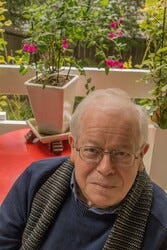
David Thomson
About The Author
David Thomson is the author of more than twenty books, including biographies of David O. Selznick and Orson Welles, and The New Biographical Dictionary of Film. His writing and his books have been featured in The New York Times, The Guardian, the Los Angeles Times, The Atlantic, Esquire, Slate, and many more. He lives in San Francisco.