
You can't just bury your head in the sand, friend.
In fact, I suspect that doing so reveals your secret agenda.

I wrote this statement below as a lead in to one of the FilmStack Daily Digest posts recently.
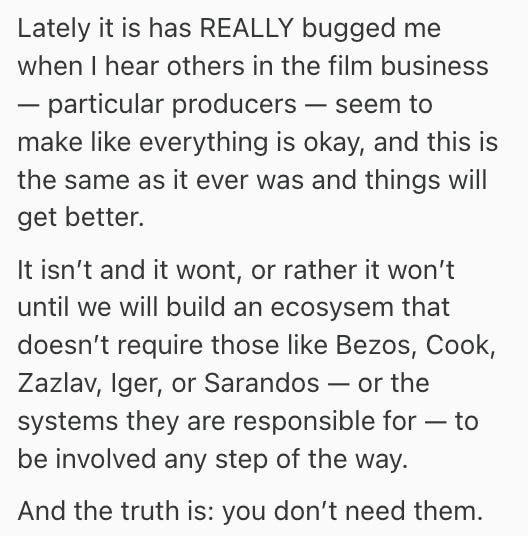
One of the things I find funny is how folks seem more desirous to argue that everything is okay, than they are to discuss why we no longer need the system that has been built. The truth is I would be more hesitant to state the first part if I wasn’t so confident of the second part.
As a film producer, I have never limited my responsibilities to getting the movie made, or even to getting it made well. If anyone is interested, I have always maintained a policy of full declaration and transparency as to what I think the full role of a film producer is. I thought doing so would catch on with a larger cohort, but few producers actually practice either such declaration or transparency. The benefits of such clarity in revealing who we are are is why I felt I needed to write my first book, and it is why I initially launched this newsletter too. I want my future collaborators to know me well. I certainly wish I could know them better.
One of the responsibilities of a producer I take quite seriously is the effort to make the world “safer” for the types of films I love and want to make. This requires a constant practice to both deliver operational improvements to the system we are in, as well as helping others recognize what that system is. This is why I do what I do and write what I write. But despite the great community here on FilmStack, I don’t find many of my producing class taking the same approach. There are many who keep saying “everything is going to be okay”.
I think the only way it will ever be okay again is if we build a non-dependent system. Sure, without doing that, some of the point-oh-five-percent will be able to keep on going, but it comes at the expense of all the other participants. Seriously. Their self-centeredness destroys it for the rest of us.
It doesn’t benefit anyone to distort our situation. We have reached such a low point in our industry that you can not chalk up an unwillingness to say “the emperor has no clothes” to a difference of opinion. Yet, I am constantly confronted by others, including my fellow producers, who are distorting the state of things. They don’t want be somehow penalized by speaking up against the existing power structure.
Don’t get me wrong, I am certainly not the only truth teller out there.
I have tried different approaches to getting the conversation going about what a system that works better for all of us is. At the end of 2024, and well into 2025, I did my best to provide a guide of everything that is wrong with our cinema ecosystem. I didn’t include perhaps the top issue in that though… why — when we are shown 224 things wrong with our cinema ecosystem — do those at the top of the leadership hierarchy refuse to do anything about it? That is the biggest problem we have now: the reticence of those with experience to address the real problems at hand.
Sure, I get people don’t like bad news. And I get that some of us get overwhelmed by the volume of crap. Not me, I think it is awesome. Why? As I told my son as he began to forge his own path in this world, he and his generation were profoundly lucky, as my generation and the ones that surround me, have so thoroughly fucked up this world that there is plenty for him and his tribes to do that is both meaningful and urgent. What a gift! Time to get to work, right? Their lives can be so meaningful!
I want to let you in on a little secret. It has helped me find the cracks where the light gets in. If I was to write the book on “how to engineer serendipity”, this would be one of the tactics. I need to prepare you a little bit first though, as much as I would prefer to just blurt it out.
I have found that when I speak some truths, it leads some to suspect — or even accuse me — of having a low opinion of humanity. I don’t, but I do think the current model of humankind is profoundly corruptible, and you have to take that into account when looking at anyone’s behavior. Forgiveness is after all one of our true superpowers.
Power resists surrender. Power will go to forever more desperate measures to hold onto what it has. Most will want more of what they perceive is the good thing, particularly if they also perceive it can get them even more such good things. This is not a good thing. We have “progressed” to such a point where the abusive and toxic leader is the product of our system. And as a result, I have developed a tendency to not trust most leaders, to not trust most people that hold power, and particularly to not trust anyone that is doing anything to hold onto power.
I have not revealed that publicly before, not that it matters. I held back as I found that when I revealed it to my close confidants, they found it incredibly dark. I don’t. I don’t find my lack of trust of those in charge “dark”; I find it freeing. And it shows me often a path to actually get things done. It is always helpful to know where others stand.
