

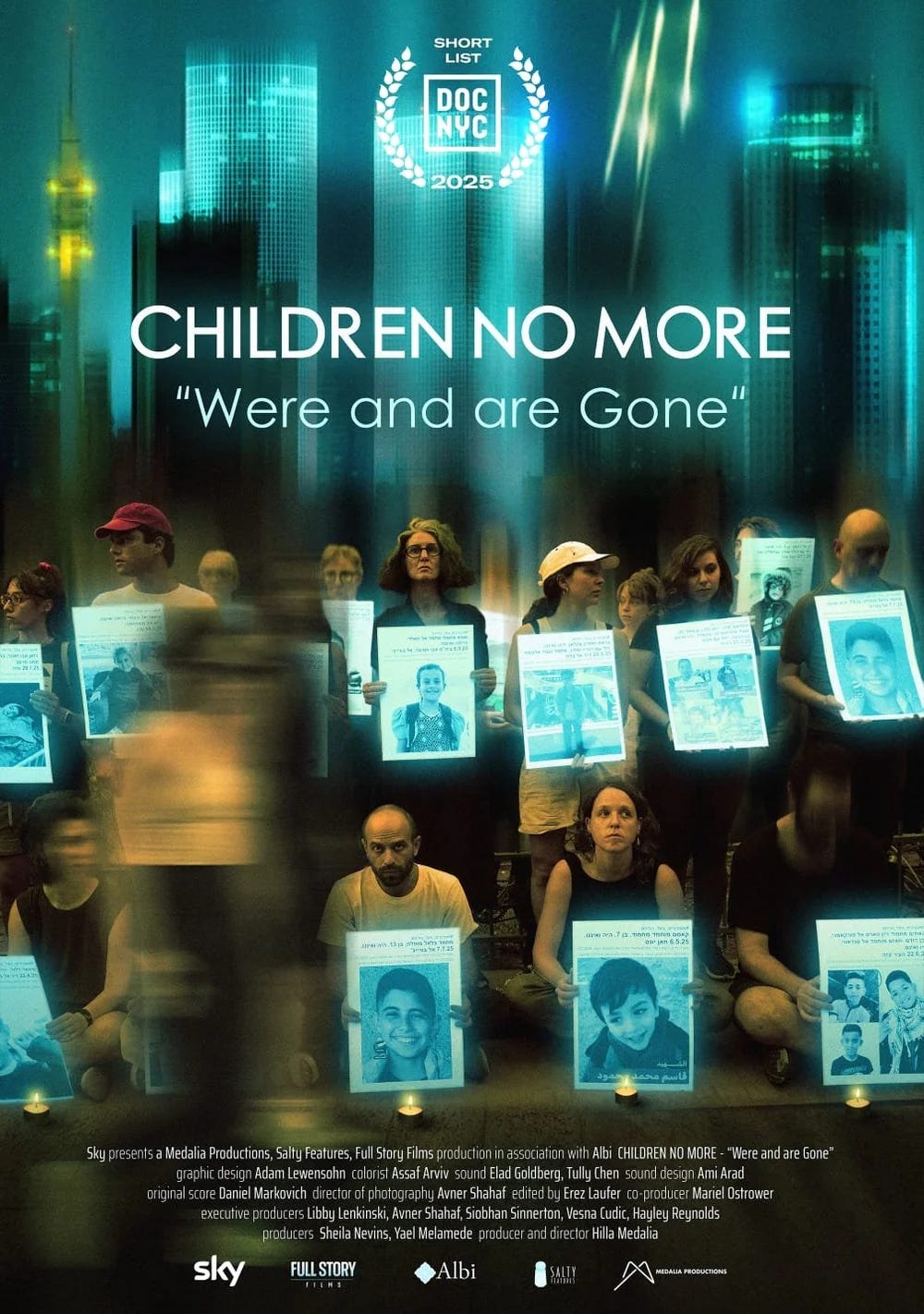
CHILDREN NO MORE: “WERE AND ARE GONE” is an ACADEMY AWARD® NOMINEE for Best Documentary Short!
transcript lightly edited for clarity and brevity
Vanessa Hope: I’m very excited to be joined by the Oscar-nominated team behind the short documentary Children No More: “Were and Are Gone,” director Hilla Medalia and producer Yael Melamede. They’ve worked together on each other’s films for years. Hilla produced Yael’s beautiful feature documentary about her mother, (Ada - My Mother The Architect) which we might go into. And Yael is an Oscar-winning producer for a short called Inocente, which we also might discuss because all of these films have relevance to what is happening in the United States and in our world today. So thank you so much, both of you, for being here.
Hilla Medalia: Thanks for having me.
Yael Melamede: Thank you so much.
Vanessa: Would you like to describe your short in your own words?
Hilla: Sure. Children No More is an observational documentary short about a silent vigil in Tel Aviv (in 2025) where activists are protesting the war with pictures of children who were killed in Gaza by Israel. Yael, you want to add to that?
Yael: Yeah, I think it’s an amazing film. I love the description of observational documentary. It’s really looking at what regular people feel compelled to do in the face of something they completely disagree with. So I think it’s a really relevant film for Israel and relevant for the world to see about Israel, but also relevant given so many issues we’re feeling today in America.
Vanessa: Yes, it is. What was the first moment, if you were observing the vigil, when you realized this should be a film, and how did you approach it from the very beginning, telling the story?
Hilla: You know, it’s been over two years now since the beginning of the war in Gaza and I keep asking myself, what do you do, what can I do to stop this war? What can I do to not be complicit? What can I do to oppose what happens? And also, of course, as a documentary filmmaker, I was asking myself, what are the stories that I need to tell? What is my role in this conflict? What is my role to stop what’s happening and to make a change?
Then this group of activists who are doing this vigil… it’s extremely strong. It was such a strong experience. I remember so clearly the first time I came to the vigil. I remember the quietness.
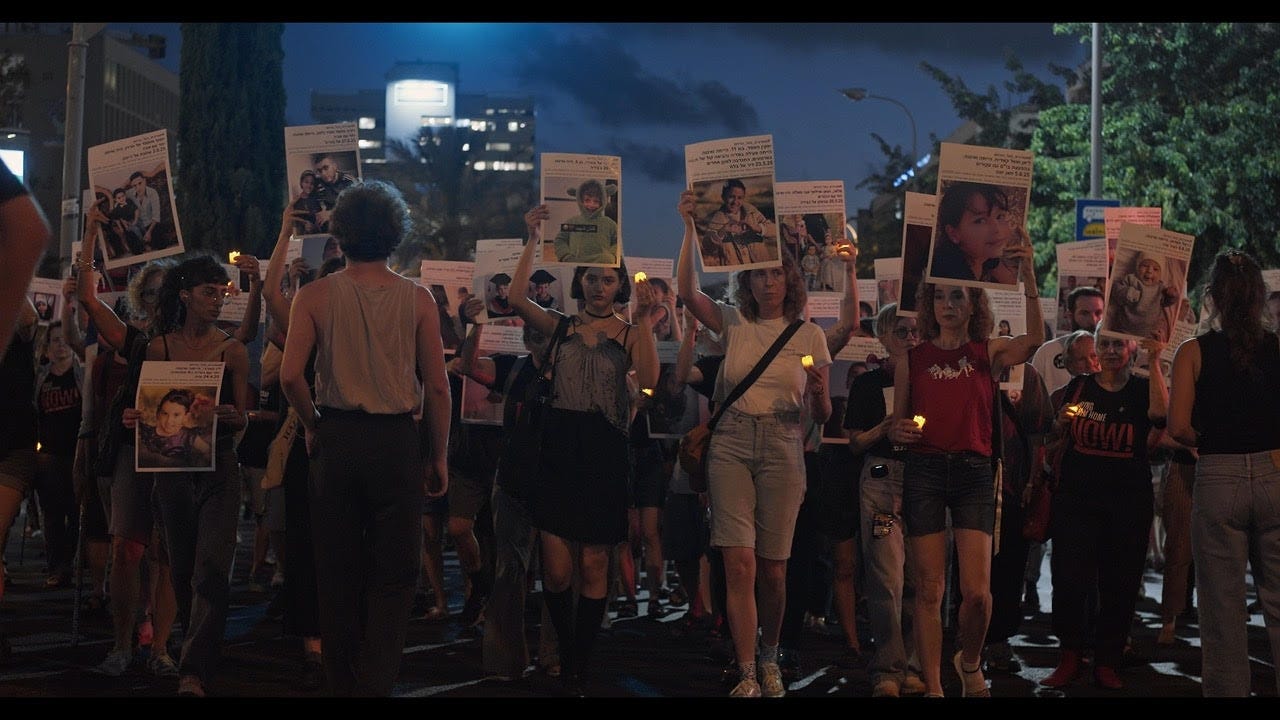
They stand quiet, they don’t talk, they each hold a poster of a child that was killed. It says the name of the child, the age, the date they were killed, and then the words “were and are no more.” Just the power of this kind of quietness is such a strong scream. I really felt it in my heart that this is something I want to tell. The same was true for the crew and everybody else who worked on the film.
It’s also incredible to see how, though they don’t say anything and it’s quiet, it really evokes emotions and sometimes resistance. Some people join them. Some people really look at the kids in the eyes and are able to connect and feel the pain in their hearts. But many other people look at them and see it as an act of betrayal.
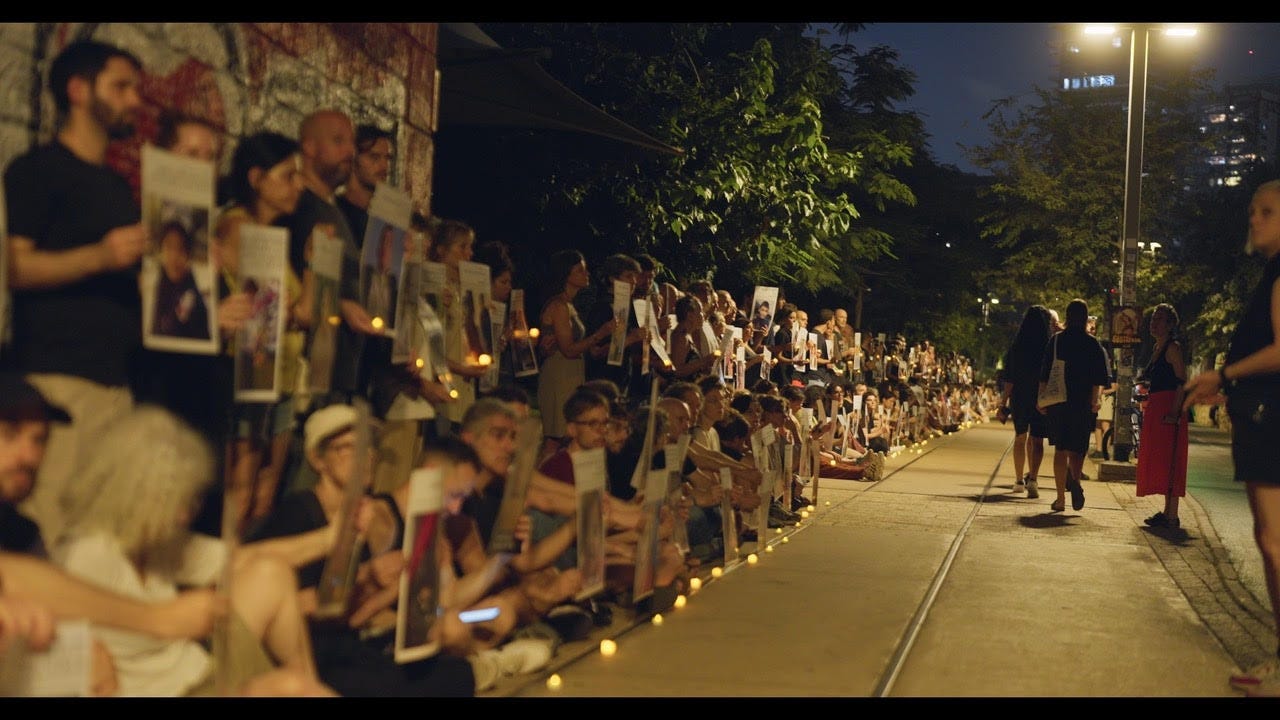
The vigil itself is so strong, but also the reaction to the vigil and how showing compassion and grief and all those emotions is really seen as a betrayal. This was really the first time we experienced that. We just really wanted to capture it. Our goal in the film was to have the audience experience the power of silence.
Vanessa: It’s very powerful and it’s very moving. Yael, how did you come to the project? I know you’re longtime collaborators, but for you, where did it begin?
Yael: Yeah, I mean, the film started so recently. This particular vigil started in March after Israel did not comply with the ceasefire. These activists started after 100 children had been killed in one day. They just felt like they had to do something.
Hilla started filming in late May, early June, and really reached out even after that, at the end of the summer, saying, “I think I have a film.” I thought it was amazing. I think it’s a really beautiful film for a lot of reasons. Israel these days is looked at with so little nuance. It’s all about right and wrong and good and bad. What I love about the film is that it’s just filled with nuance and empathy, and we don’t see that very often.
While I personally and politically agree so much with the protesters, one of the things I love about the film is that I have empathy for the people who get angry at them. You feel their pain. One of the people who gets angry at the protesters yells at them and says, “Can’t you have one image of a hostage?” The hostages were still in Gaza. Again, I don’t agree with him. I think we can hold two things at the same time. We can hold empathy and anger about what is happening in Gaza and also be incredibly angry about hostages being held. But I understand his perspective, and I think that’s really helpful. To me, the hope is that people will see this film and be able to see a place like Israel with more nuance.
Vanessa: Yes, and I think you’re right. We don’t really get a sense of what’s going on in the country and what people are thinking and feeling there. It’s so beautifully rendered, this sense of community and solidarity and the quiet vigil. How did you think about maybe protecting the people who you were filming? Were you nervous for them, for their safety in having a camera? Or maybe the camera added protection because visibility meant people who would object to the vigil might not want to act out?
Hilla: I mean, the activists are extremely brave. A lot of them are doing a lot of other things. The vigil is one thing they do. A lot of them are going to the West Bank and protecting, with their own bodies, Palestinians against the ongoing violence of the settlers and the army in the West Bank.
I don’t know if there was necessarily fear. They are really out there. What’s very special to me in what they’re doing is that they’re actually trying to avoid confrontation. When they feel that the situation is too heated, they usually just finish and go.
When we premiered at DOC NYC, in the Short List category, someone in the audience asked them, “How do you handle it when people who are really close to you—your family, your close circle of friends—disagree with you?” They said that they try not to fight but actually listen and then continue saying what they have to say with the hope that they will be heard. That was really strong for me personally—a lesson I learned from them on how, on one hand, to avoid violence but, on the other hand, to keep standing and keep stating the message.
What’s happening in Gaza is not really existent in the media in Israel. We don’t see what you see outside of Israel. So obviously people are reacting the way they react because they’re not used to seeing these images. It’s very difficult. It’s hard to think that it’s being done in your name. But we need to know what’s really happening there. It’s difficult, but hopefully it moves people. For me it’s really about humanity. We need to remember that even with all the trauma and everything that happens to us, we need to remember our humanity and value the lives of others.
Vanessa: Yes, and we in the United States need to learn from this and be in the streets also protesting. Yael, we were speaking about that in the context of ICE and what’s happening here. Hilla, you’re in Tel Aviv now, but Yael, you’re in New York City. Both of you go back and forth and understand both countries. Are you feeling that this is the lesson we need to learn here, too? Because without that kind of protesting in the streets, we won’t really be able to make a difference here either. And then, Hilla, I didn’t realize that about the media in Israel. I wonder, will your short be seen there? Can it reach people there?
Hilla: So actually, next week we are starting to screen it in theatres and in different community centres and places. The film was made with no Israeli funding or broadcaster support at all.
Will it be broadcast? It’s a good question. I’m not sure. Some of the messages from the activists, are extremely difficult for the Israeli audience. It’s really hard to think that such bad things are happening in your name.
The activists always talk about how one killing, one tragedy, one trauma doesn’t give you a license to do the same or to kill others. But still, it’s extremely difficult. It’s a traumatized society and the broadcasters are very protective. They want their audience and they don’t want to create controversy. There is a lot of self‑censorship, and that’s the problem. I’m really blaming the media and blaming the journalists.
So I’m not sure we will be able to find a real home within Israel. But at least we’re bringing it independently to audiences. If we don’t find something more wide, we’ll make it available on some kind of VOD or a platform like Kinema.
Yael: Yeah, and I think the same is actually true in the US. We have an amazing partner in Sky in the UK, but we don’t have a partner yet in the US. Given this political moment, I don’t think it’s about anti‑government feeling here, but about a reluctance to do anything political and a tendency to shy away from it. So we may be in the same situation here with distribution.
I do think there’s something different with a short than a feature. It’s much harder to get theatrical distribution, but in some ways the film can do a lot of good work because it’s really easy to build an event with the film and then a discussion. We had an amazing discussion a few weeks ago here in New York with another filmmaker and a Palestinian journalist who had left Gaza a few months ago. Using the film to bring people together and have difficult conversations can be very powerful.
We’re talking to somebody about possibly doing a screening at the UN. It becomes easier when the film is shorter. We’re really excited about that. And I do think the activists are pointing something out. A lot of people think that silent protest isn’t very powerful and ask, “What does protest do anyway?” But protest makes people aware. It rings this bell that you can’t not hear, even when it’s silent.
They are very strategic. You see in the film that each time, they’re learning from what they do and trying new things. Some of them work, some of them don’t. I really loved when one of the protesters comes into contact with the police and he asks, “Do you have a permit?” and she says, “We don’t need a permit. We are a silent vigil. We are not making any noise, so we don’t need a permit.” I was like, wow, that’s really smart. I immediately looked to see whether, when there’s a silent protest, you need a permit in New York City. Even if that’s not the right strategy, thinking about strategy and thinking about how to have an impact is what we all have to strive for and learn from.
Vanessa: Yeah, absolutely.
Hilla: And by the way, it’s important to mention that, first of all, the vigil continues now. It’s been a relatively hard winter for the region. A lot of Gazan people are living in tents and in really bad situations, so they are protesting against that situation. It’s been over three months since the ceasefire started and almost 500 people have been killed in Gaza since the ceasefire. So there is still a lot of information and a lot of reason for them to continue their vigil.
It’s also important to mention that there are vigils all over the world, including in New York City, LA, London, and other cities, sometimes joined by Palestinians and by people from different backgrounds and religions. It’s really becoming this global movement—unorganized, but basically activists coming together in different cities and standing, doing this quiet vigil.
Vanessa: Yeah, that’s beautiful.
Was it hard to figure out where or how to end the short? And how did you know it was a short and not a feature?
Hilla: I think when we started, the goal was very simple. There has been a big movement against the government in Israel—even before the war—for a lot of anti‑democratic moves the government has been making. That started maybe a year before the war. When the war began, these protests continued against the war, against the government, and for the release of the soldiers—to end the war because it doesn’t make sense. But it wasn’t necessarily about the situation of the people in Gaza and how they’re dying and losing their homes.
The vigil began within this anti‑government protest, bringing this message and this voice that doesn’t exist in the media into that space. When we started the film, we thought we wanted to create the feeling of the vigil—more of a cinematic experience—because the feeling was so strong.
Then what happened is that soon after we started filming, the activists felt that they wanted to go outside this anti‑government environment and move into different public squares and spaces. We followed them, and that is when it really became very tough and they got really bad reactions. In a way, the story grew. At the beginning we didn’t even know if we could explain the anti‑government protest.
We also made the film very quickly because when we started, we felt the urgency. The war was still going. We felt that we needed to get the film out as soon as possible. We knew we wanted to make it a short. We started in June and finished so that on September 23rd it was already screening in theaters in LA, which also qualified it for the Academy. In November it premiered. Everything happened really fast. Of course, now the nomination is really allowing us to bring the film to the audience. That’s the most important thing.
Vanessa: Yeah. Do you want to add anything to that, Yael? I think you’re absolutely right—you’re going to reach a bigger audience this way with this nomination, which is a really big deal.
Yael: Yeah, I’m a big believer in the idea that, like buildings in architecture, films tell you what they want to be. I think it was really clear to Hilla very soon that there was an urgency to the story and that it was meant to be a short. When we worked with our trailer company, one of the editors said something so nice: “This is a perfect short. You get to see something you know nothing about and then you’re done.” I thought, that’s so interesting.
I think very few people outside of Israel appreciate how much protest there’s been. There’s been one of the largest protest movements ever in Israel. Most of my friends have been protesting for the last two and a half or three years every single weekend. On the one hand, you could say, well, they haven’t done very much. On the other, I think they are continuing to show the government that there are people who care and who are against these policies, and hopefully will be part of creating some kind of change in the coming year when there are elections in Israel.
Hilla: I love your optimism. I’m very depressed about what’s happening, though I continue to do what I can—which is also something I really learned from these activists. It’s very easy to sit at home and say, “The situation is horrible, people are being killed in our name, there’s all this destruction,” and to do nothing because it’s easy to sit at home. I think every one of us should do whatever we can. Even a small thing is part of making a change.
Unfortunately, I feel that what’s happening here with the government is that it keeps taking away rights and freedom from creators and from the news. When it was announced that the film is nominated, the first thing the culture minister did was try to use it as an example of a film that amplifies the message of “our enemy,” and that Israeli culture should not support. He never watched the film. We did not get any public funding. But it’s good for him for his election, so he’s been using it and attacking. We’ll see what happens in the next weeks when we start screening the film here.
Vanessa: On that note, I’ve been reading a book you may have heard of called Strongmen by Ruth Ben‑Ghiat, and thinking about how you mentioned that it was women who started this vigil. Strongmen are very fearful of women speaking up and of culture making a difference and reaching people. It’s a sad situation the whole world is in right now, with democratic backsliding in so many countries. Most of the world lives under some form of authoritarian government, and those of us in democracies are seeing them backslide. I don’t know if following women or women initiating this was in your mind as something that’s particularly counter to authoritarianism or emblematic of democracy and strengthening it. There are great men in the silent vigils too, everywhere, and it’s very moving to see.
Hilla: The organizers are women. When we screened the film, someone from the UN who was there spoke about how this women‑organized group has no single organizer and no hierarchy. That’s very interesting. Right now, even with all the talks to stop the war and all the negotiations with Hamas—of course, there are no women in Hamas—but there are also no women representing Israel. It’s all a bunch of men, and it’s really fearful.
In the current Israeli government there are very few women compared to previous governments, and it’s been really bad. This activist group is an example of real women organizing. There are a lot of men who stand with them, but the people behind it are mostly women.
Vanessa: Was that attractive to you, Yael? You had a very powerful mother growing up, who’s an accomplished architect. Does this speak to you?
Yael: You know, I think it’s great to observe. I think there is something now, because women have not had power traditionally, that makes women different. But having been steeped in a lot of behavioral science, I don’t know if women would be different if we had had power for a long time.
So I don’t want to say that this is innately female or male. But as a result of our recent history, I think there is something to learn from the way these young women are conducting and organizing themselves. It’s a model for everyone.
Vanessa: Yeah. That model that Hilla describes so well is a feminist model, and men can partake in it. It’s Ted’s model for independent film these days too. It’s a good model for bringing democracy back into our lives and modeling it, really.
Where do you see the film leaving audiences? How are audiences in different countries responding?
Hilla: So far, the audience has been limited, of course, to Academy members. The fact that Academy members voted for the film is very inspiring. Our goal is to use the film to deliver the message—to show these activists and what they did, to show this point of view, and to stop the war. No child and really no one should die in this war. The destruction of these two years didn’t help solve the problem. It doesn’t give us security here that another October 7 won’t happen again. All it did was create more bloodshed.
I think it’s time for justice and rights for everybody, and for the right to self‑determination. There’s a lot to learn from these activists—how brave they are and how they’re willing to put themselves out there. On the other hand, one of the strongest elements is the power of silence. Another is how feeling grief and the pain of a Palestinian child who was killed is seen by others as betrayal. That’s really unheard of to me, because I feel that we should all be humane. We should all be able to feel this and to fight so that it doesn’t happen to anyone.
Vanessa: Yes, that’s so beautifully said. That is definitely a takeaway—that is what I felt watching your film. Yael, do you want to add anything to that?
Yael: I think we’re at such a weird tipping points in so many places in the world, but I do continue to believe that history is long and bends towards justice. Even if there are darker times ahead, these are really important movements that help bring down authoritarian governments. It’s important to continue. It’s important to find ways to keep showing up. That’s true in Israel, and it’s becoming increasingly true here.
If we look at our own history in the US, the civil rights movement took a long time. There were lots of moments that were incredibly depressing and horrifying, and then something shifted. I hope that will be the case here too. But it is really daunting. It’s incredible that Hilla is in Tel Aviv now and that America may be moving on Iran, and that her kids’ school is being prepared as a shelter. It’s just a really crazy time.
Vanessa: It is.
Well, I hope everyone has a chance to see your film. I would love to know if we can share where they might see it—if there are screenings coming up.
Hilla: Sure. It’s going to be in theaters starting February 20th throughout the United States with a group of other nominated shorts. In the UK and Ireland, it’s available on Sky. In Israel, we’re just starting screenings because I think the film has a role internally and externally. Hopefully there will be more coming up and we’ll share them with you so you can share with your listeners.
Vanessa: Thank you. Thank you so much.
One question in the back of my mind was: is this phrasing “Children No More: Were and Are Gone”—the words “were and are gone”—a translation?
Hilla: Right. Every poster has a picture of a child, his or her name, age, the date they were killed, and where they’re from. There are also two phrases. On the top it says, “Involved against their will,” and underneath it says, “Was and is no more,” or “Were and are no more.” We tried to use that in the name of the film.
Yael: “Children No More” is the name of the campaign behind the vigil.
Vanessa: Yeah, it’s beautiful. I hope everyone can see it. Thank you both for joining. We’ll spread the word, and I really hope this film gets out there and makes the difference that it should. Thank you.
Yael: Thank you so much. Thanks for having us.
Hilla: Thank you.
Hilla Medalia is a Peabody Award-winning director, producer, and writer who has received four Emmy nominations. Her work has garnered critical acclaim and screened internationally in theaters and on platforms including HBO, MTV, PBS, BBC, and ARTE. Her range of titles includes ADA – My Mother the Architect (2025, Jerusalem Film Festival), Prisoner X (2023, Jerusalem Film Festival), Mourning in Lod (2023, MTV Documentaries, DocAviv), Innocence (2022, Venice International Film Festival), H2: The Occupation Lab (2022, Hot Docs, FIPADOC), Love & Stuff (2020, Hot Docs, DOC NYC), Leftover Women (2019, Tribeca, ARTE), The Oslo Diaries (2018, Sundance, HBO, ARTE), Muhi (2017, IDFA, Hot Docs), Censored Voices (2015, Sundance, Berlinale), The Go Go Boys (2014, Cannes), Web Junkie (2014, Sundance, POV, BBC), and Dancing in Jaffa (2013, Tribeca, IFC). Hilla is a member of the Academy of Motion Picture Arts and Sciences and the Producers Guild of America, and she holds an M.A. from Southern Illinois University.
Yael Melamede is the co-founder of SALTY Features, an independent production company she launched over two decades ago to tell stories that are thought‑provoking, vital, and designed to enhance the world. Driven by deep curiosity about people and systems, her work explores the messy, often contradictory nature of human experience. Her recent projects include Children No More – Were and Are Gone (directed by Hilla Medalia), a moving portrayal of a powerful silent protest movement in Tel Aviv and currently nominated for an Academy Award for Best Documentary Short; Death & Taxes (directed by Justin Schein), a personal and provocative look at America’s flawed tax system; ADA – My Mother the Architect, an award‑winning portrait of her mother, architect Ada Karmi‑Melamede; Floyd Abrams: Speaking Freely, an Emmy‑nominated film exploring free speech through the life of First Amendment attorney Floyd Abrams; and Pay or Die (directed by Scott Ruderman and Rachael Dyer), a powerful examination of the devastating insulin crisis in the U.S. Additional credits include the Academy Award‑winning Inocente, the Emmy Award‑winning When I Walk, the Academy Award‑nominated My Architect, (Dis)Honesty – The Truth About Lies, the series Why We Hate, Brief Interviews with Hideous Men, and The Inner Life of Martin Frost. Trained as an architect, Yael brings a design perspective to storytelling, serves on the boards of UnionDocs and the Living City Project, and is a member of the Documentary Producers Alliance and the Academy of Motion Picture Arts and Sciences.


